

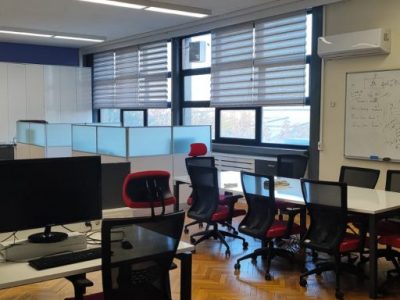
A fully instrumented environment for testing IoT control algorithms and Reinforcement Learning in real-time.
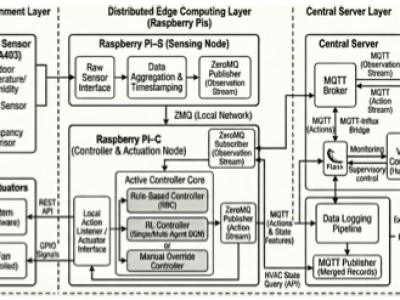
A real-time, dynamic, multi-threaded system using a fast API has been developed to enable us to set up remote testing algorithms. Sensor data is transmitted to this system via a local MQTT broker. After all sensor data is collected, the system saves it to the database.
The system also supports a manual mode where control can be established over each AC unit and fan using a simple GUI. Cloud-based modes are used to offload heavier RL inference to server systems. Rule-based systems are executed directly at the edge.
Energy consumption, air quality, temperature, and humidity can be monitored in real time.
Test how the building operates in different scenarios to improve performance.
More effective management of resources through data-driven insights.
Control and manage smart building parameters securely over the internet.
Proactive monitoring helps in predictive maintenance of building systems.
Reducing carbon footprint and complying with green building standards.
Cloud-based servers were initially used to enable rapid deployment. As development progressed, more components were moved to the edge device, eventually transforming the entire system to run independently on a Raspberry Pi 3.
Sensor data acquisition, cleaning, and rule-based controller inference are performed locally. A local MQTT broker ensures the device can reliably exchange messages and broadcast to the database even without internet access.
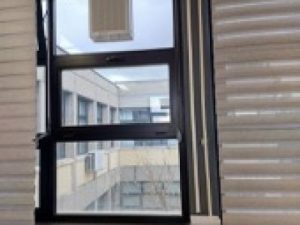
A standard, manually controlled window fan is equipped with a control board, enabling remote control. This transforms the device into an IoT device. Rule-based and RL-based control is enabled to maintain acceptable CO2 levels.
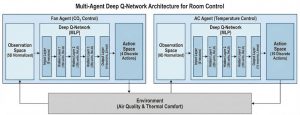
Our setup supports multi-agent Reinforcement Learning scenarios where different environmental parameters (temperature, air quality) are managed by independent or cooperative agents running on edge hardware.
Bridging the gap between simulation and reality using Reinforcement Learning.
A-403, Dept of EEE, METU
Ankara, Turkiye